skip to content
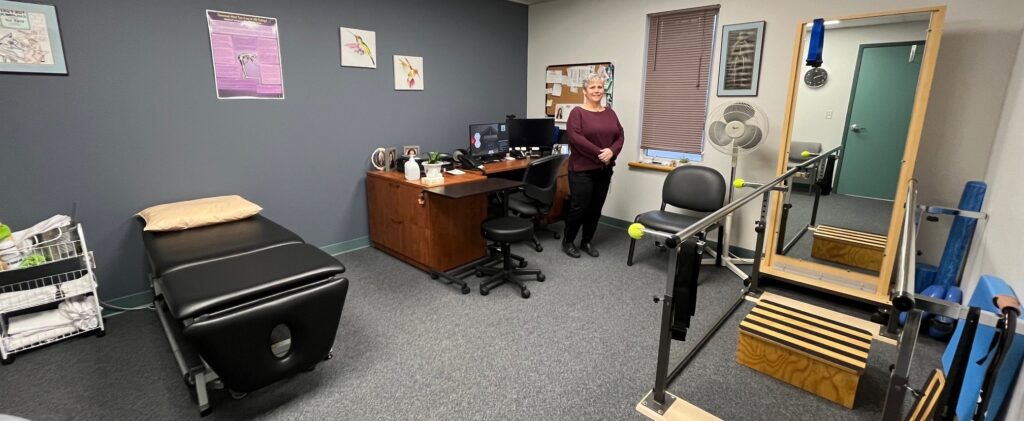
Jody Lemieux, Physiotherapist is in her physiotherapy clinic in Northern Ontario.

Jody Lemieux is a registered physiotherapist at the Huron Shores Family Health Team in rural Northern Ontario. With more than 30 years of clinical experience, Jody has worked across hospital, private practice, home care, and community settings. For the past two and a half years, she has been practicing in a primary care team, supporting a large and geographically dispersed population across Blind River, Thessalon, Bruce Mines, and Richards Landing. 

Jody’s move into a primary care team was motivated by a desire to work in preventive care. After years in acute and inpatient hospital care, particularly during and after the COVID-19 pandemic, she observed many hospital admissions that she felt could have been prevented with earlier intervention.

“So many people were coming in with failure to cope,” she explains. “If there had been some intervention earlier on, it definitely could have prevented that or at least delayed it quite a bit.” 

The State of Primary Care in Rural Northern Ontario 

Providing physiotherapy in primary care in Northern Ontario looks very different than in urban or southern regions of the province. Jody’s Family Health Team’s catchment area encompasses more than 14,000 people and spans a vast geographical region, which includes communities without consistent physician coverage. Approximately 7,000 individuals have access to a primary care provider through her health team’s four sites. Although many others across this area have access to a primary care provider through other means, a significant number remain without a primary care provider. Also, there are no walk-in clinics in the region, and two of the three emergency departments are regularly closed due to lack of physician coverage. Thus, the Huron Shores Family Health Team endeavours to provide certain programs that are accessible to all individuals, irrespective of their clinic roster status. 

“Rural Northern Ontario is totally different,” Jody says. “The geography, the travel, the lack of resources, all of those things matter.” 

Because of these realities, Jody worked closely with leadership and regional partners to develop a role tailored to community needs. “The slate was wide open,” she notes. “I was able to look at what our population actually needed and build something that made sense here.” 

A Focus on Healthy Aging and Prevention 

In addition to providing individualized physiotherapy services, a major component of Jody’s role has been the development of a comprehensive Healthy Aging Program. The program focuses on early identification of frailty, falls risk, bone health concerns, and other barriers to aging well. The Healthy Aging program is available to everyone, including screening and education sessions, regardless of roster or attachment status, or ability to pay. However, the screening component is currently only for those 65 and older.

“It’s about identifying issues early and addressing them before they become crises,” Jody explains. “A lot of these things are not even discussed with primary care providers,” Jody explains. She adds that physician and nurse practitioner workload constraints are significant barriers to screening and addressing needs related to healthy aging, including falls risk and preventive care.

The screening process is intentionally thorough, combining early frailty identification with a pre-falls pathway to ensure important risks are not missed. Jody notes that this blended approach has helped identify individuals who may have otherwise been overlooked: “We’re catching a lot of other problems by taking the time to ask the extra questions.” 

Measuring Impact and Delaying Long-Term Care 

The Healthy Aging Program has been supported through funding from Healthcare Excellence Canada as part of the Enabling Aging in Place Collaborative. While some outcomes are still being formally measured, early feedback has been overwhelmingly positive. 

“All of the clients surveyed either agreed or strongly agreed that the program is helping them age in place longer,” Jody shares. Participants also reported highly positive experiences with the screening process itself. 

The screening aspect of the program has generated dozens of referrals to physiotherapy, primary care providers, diagnostic testing, bone health assessment, and community supports. In some cases, osteoporosis and other chronic conditions were identified for the first time, allowing for earlier education and management. 

Team-Based Care and Expanded Capacity 

Jody emphasizes that this work would not be possible without interdisciplinary collaboration. Nurses now lead the screening process at each site and assist with providing fall prevention programming. This allows Jody to focus on program oversight and more complex clinical needs. Recently, base funding was secured through the Algoma Ontario Health Team to support a permanent physiotherapist assistant (PTA) three days per week, which further supports community needs. 

“Having a physiotherapist assistant has made a huge difference,” Jody says. “A lot of what I do is education and exercise-based care, and that support helps us reach more people.” Jody adds that the PTA who works with her provides tremendous benefit to the community. They not only offer various group exercise classes and lead the fall prevention programming, but they also support Jody in working with her one-on-one physiotherapy caseload. 

Jody also highlights the importance of team-based solutions when unattached patients are going through the Healthy Aging Screening. In these cases, a nurse practitioner supports follow-up and diagnostics when needed, helping maintain continuity of care within the team. 

The Value of Physiotherapists in Primary Care 

Jody believes physiotherapists are uniquely positioned to strengthen primary care, particularly in underserved and rural regions. “We’re regulated health professionals with a lot of education and training,” she says. “When it comes to musculoskeletal issues, bone health, chronic disease management, and healthy aging, we’re well suited to identify problems and refer appropriately.” 

She also notes the value of time and patient connection. “We get to spend more time with people. Patients often tell us they’ve never been asked these questions before or that they were worried about something but didn’t want to bring it up because there were so many other things to talk to the doctor about.” 

For Jody, primary care physiotherapy is empowering, preventive, and flexible. “We’re all aging. There are a lot of modifiable factors, and people are eager to learn what they can do to help themselves.” 

Looking Ahead 

As Ontario continues to invest in team-based primary care, Jody hopes more teams will consider how physiotherapist roles can be adapted to meet local needs. “It doesn’t have to look the same everywhere,” she says. “It’s about identifying what your community needs and being open to doing things differently.” 

Her work demonstrates how physiotherapists can support healthier aging, reduce strain on hospitals, and improve access to care, particularly in rural Northern Ontario. As Jody puts it, “The sky is the limit when you’re willing to think outside the box”. 

Are You our Next Member Spotlight?

Do you want to be featured? Are you in an innovative role? Spoken about physiotherapy in a podcast or the news? Published an article? Or represented the physiotherapy profession through advocacy?

We want to celebrate you as a physiotherapist, PT or PTA student or PTA!

Details

Date

January 30, 2026