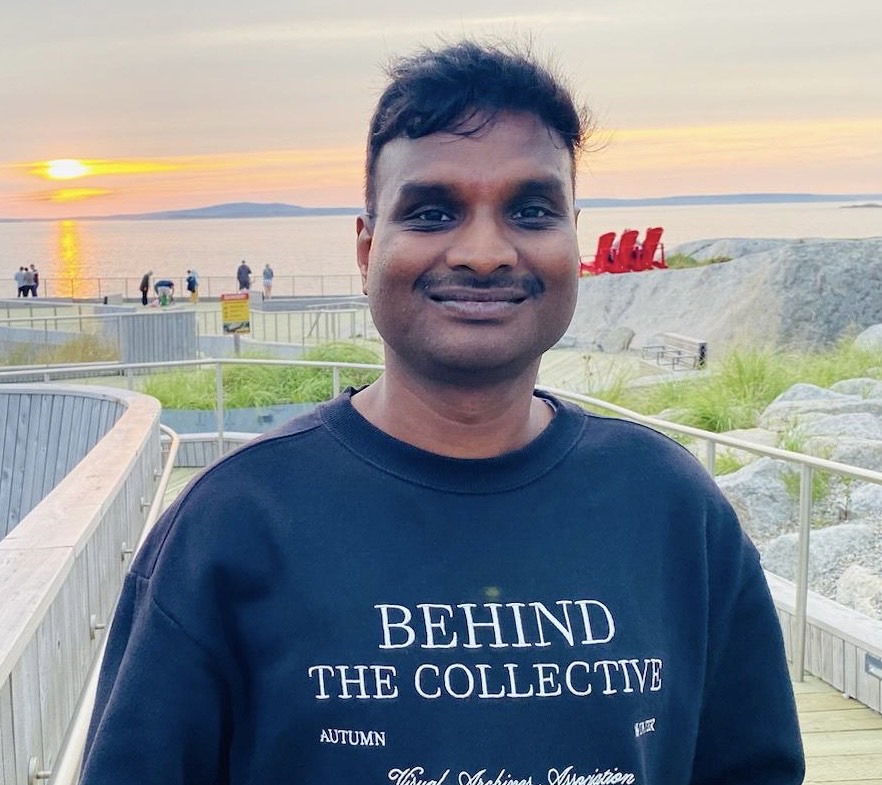
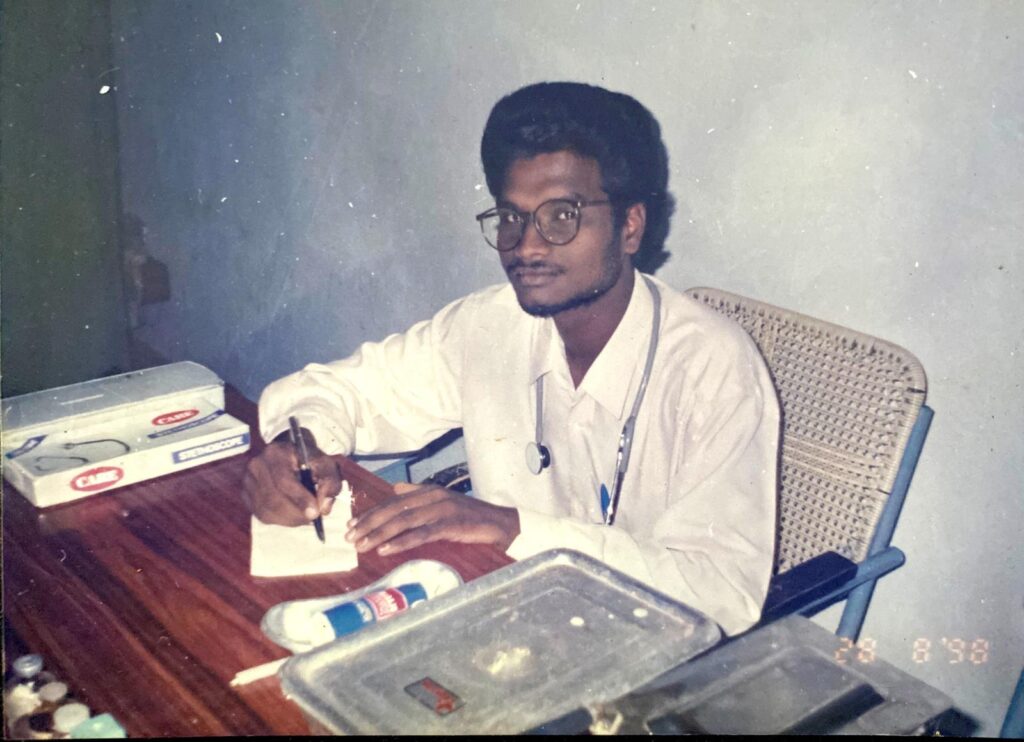
After pausing his formal education for several years due to family responsibilities, he immersed himself in hands-on healthcare. He worked in a rural pharmacy setting and assisted in hospital as a medical assistant and surgical assistant, eventually helping establish a community first-aid service at just 18. Alongside this, he demonstrated early leadership by founding a private school and managing a team of tutors while completing his secondary education.

Venkata went on to earn his Bachelor of Physiotherapy in 2005, overcoming the challenge of transitioning to an English-language curriculum. As a student, he founded the Samaikya Andhra Physiotherapy Students Association and took on a leadership role advocating for peers. He later established and expanded multiple clinics in India while continuing his education, completing a Diploma in Pharmacy and a Master’s in Orthopedics and Trauma.
In 2013, Venkata brought his combined experience in clinical care and leadership to Canada. Since becoming a Registered Physiotherapist in Ontario in 2014, he has remained focused on integrating strong clinical reasoning with compassionate, patient-centered care.
Over the years, he has pursued advanced training in Orthopedic Manual Therapy (COMPT), the McKenzie Method (Cert. MDT), Gunn Intramuscular Stimulation through the University of British Columbia, and medical acupuncture through McMaster University.
As his experience deepened, so did his clinical focus. He became increasingly drawn to the complexities of spinal conditions, particularly scoliosis and kyphosis. This led him to complete certification in the BSPTS-Schroth method and to pursue further advanced training through the Italian Scientific Spine Institute (ISICO). Through this work, he developed a more nuanced understanding of how posture, movement patterns, and structural changes interact over time.
While treating patients with spinal conditions, Venkata began to notice a recurring pattern. Some issues that appeared to originate in the spine were influenced by factors elsewhere in the body.
“I started noticing that certain spinal problems were not just coming from the spine,” he says. “They were sometimes influenced by movement patterns and biomechcnical factors originating at the foot and lower limb.”
This observation led him to explore the relationship between spinal alignment and foot biomechanics more deeply. To strengthen this connection in his practice, he pursued formal education in chiropody at The Michener Institute of Education at UHN. By combining these areas of expertise, Venkata has developed a more integrated approach to care. Rather than treating isolated symptoms, he looks at how different parts of the body interact and contribute to overall function.
Over the course of his 20-year career, Venkata has come to value clinical judgment as one of the most important skills in physiotherapy. He recalls instances where patients presented with what seemed like routine musculoskeletal concerns, but further assessment revealed the need for medical referral.
“It’s not just about treating. It’s about knowing when something does not fit the usual pattern and taking a closer look,” he explains. This mindset continues to shape his daily practice. It also informs the way he mentors students and colleagues, encouraging careful assessment, critical thinking, and a strong focus on patient safety.
Venkata’s contributions extend beyond his clinical work. As the founder and first president of the Halton Telugu Association, he has helped create a space for Telugu families to connect and support one another across the region. “Moving to a new country comes with challenges that go beyond work,” he says. “There is also the cultural adjustment and the need to feel connected.” Through this initiative, he supports families, mentors younger members of the community, and helps preserve cultural traditions within Canada’s diverse social landscape.
“For me, it is about creating a sense of belonging,” he adds. “In healthcare and in life, connection and support make a real difference.”
Reflecting on his own journey, Venkata sees the transition to Canada as more than just a licensing process; it is an opportunity to build meaningful connections and community.
“For internationally educated physiotherapists (IEPTs), my advice is to stay patient, open, and engaged,” Venkata says. “Seek mentorship early but also be willing to share your own experiences. Your clinical background is not something to set aside, it is something to build upon.” He emphasizes that joining professional associations and local cultural groups can create a dual support system that provides both clinical guidance and a sense of belonging.
For Canadian-trained clinicians and leaders, Venkata highlights the value of active inclusion. “Internationally educated physiotherapists often bring a wide range of clinical exposure from diverse, high-volume settings. Recognizing and integrating these perspectives strengthens our teams and enhances the care we provide.”
“When we create environments where people feel valued and supported, everyone benefits,” he adds. “It not only helps clinicians grow but also allows us to better serve the diverse communities of Ontario. Ultimately, it is our patients who benefit the most from that collaboration.”
Today, Venkata continues to grow as a clinician, educator, and community leader. His work reflects an integrated perspective that brings together advanced physiotherapy, specialized scoliosis care, and foot biomechanics. He remains committed to learning and to refining his approach with each patient he sees.
“Every patient teaches you something,” he says. “That is what keeps the work meaningful and keeps you moving forward.”
Do you want to be featured? Are you in an innovative role? Spoken about physiotherapy in a podcast or the news? Published an article? Or represented the physiotherapy profession through advocacy?
We want to celebrate you as a physiotherapist, PT or PTA student or PTA!