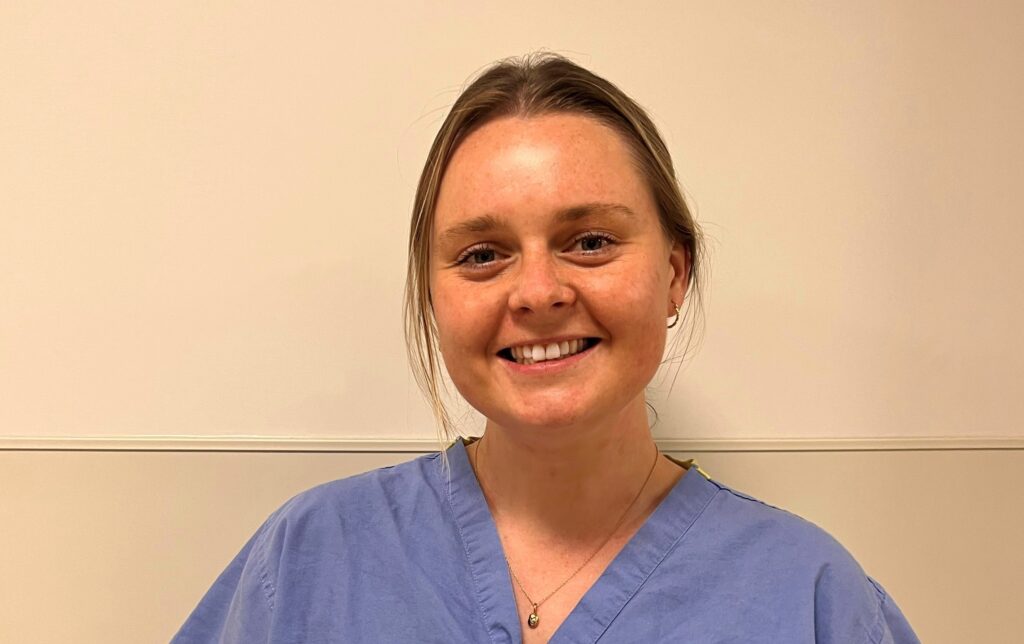
“Our primary goal was to enhance patients’ functional mobility and support discharge planning, whether that meant returning home with supports, transitioning to community programs, or entering long-term care.” Madison explains. Later, she transitioned to the rehabilitation unit at Finch Site RCC, treating geriatric patients with varying rehabilitation needs.
In March 2025, Madison took on a completely new challenge: establishing a physiotherapy presence in the Charlotte & Lewis Steinberg Emergency Department (ED) at North York General Hospital (NYGH). It was as brand new position for this hospital. “I was responsible for developing and defining the scope of the physiotherapy role within this fast-paced environment,” she says.
Unlike most physiotherapy roles in emergency departments, Madison’s work primarily targets admitted patients who remain in the ED while awaiting a bed on an inpatient unit. With patients often spending more than 24 hours in the ED due to high hospital volumes, her role is critical in preventing early deconditioning. “These patients are at significant risk of complications like pneumonia, delirium, and functional decline,” she explains. Early mobilization is essential to preserving independence and ensuring a smoother recovery.
Because the role was entirely new, Madison had to build everything from the ground up.
“Through trial and error, I established an effective workflow and clinical routine,” she says. “A critical part of this role is determining which patients are appropriate for mobilization, particularly given the medical instability and diagnostic uncertainty often present at this stage.”
When patients present to the ED, there is often limited information available about their background and overall functioning. As one of the first health professionals to assess many of these patients, Madison plays a vital role in collecting functional and social histories, often uncovering information that hadn’t yet been captured. “Families and patients have disclosed falls, cognitive concerns, or weight loss that hadn’t come up in previous conversations,” she notes. “By identifying these concerns early, I am able to relay key information to the appropriate team members and support timely interventions during hospitalization.”
The value of Madison’s role expands far beyond her assessment skills and encompasses the compassion and patient-centered approach she brings. “Even though I may have seen many patients with similar conditions, I remind myself that for the individual in front of me, this is new, frightening, and overwhelming,” she reflects. “What feels routine to me as a healthcare provider is, to them, a life-altering moment.”
Her role has been particularly impactful with geriatric patients suffering from conditions like urinary tract infections, pneumonia, delirium, and failure to cope. Madison’s role is critical in these cases, as this patient population is at risk for significant decline after only a few days of hospitalization: “A patient who walked independently at home could become unable to ambulate more than five meters after just one or two days in hospital,” she explains. Interventions such as therapeutic ambulation, supporting patients to mobilize to the washroom, transferring to a bedside chair for meals, or simply encouraging them to dangle at the edge of the bed can have a significant impact on reducing deconditioning and maintaining functional independence.
In addition to preventing deconditioning, Madison’s assessments often support complex discharge planning. She assists with stair assessments, mobility strategies for patients with complex conditions, and supports discharges directly from the ED, helping avoid unnecessary hospital admissions.
Madison’s role also aligns closely with system-level goals like reducing hallway medicine and improving patient flow. Collaborating with the Geriatric Emergency Management (GEM) nurses, Madison has helped streamline transfers directly to inpatient rehabilitation facilities, thereby avoiding acute admissions and ensuring patients receive the focused support they need.
“Through established relationships with several rehabilitation hospitals across the Greater Toronto Area, we have developed an efficient process to identify suitable patients [for inpatient rehab], set goals and care plans, complete applications, and successfully facilitate admissions and same-day transfers,” Madison shares. This process has been particularly impactful in reducing admissions to acute care units and reducing the associated risks.
To make a lasting impact, Madison believes it’s critical for both decision-makers and healthcare providers to recognize the value of physiotherapy and early mobilization. “Deconditioning begins within hours of immobility,” she stresses. “In just 24 to 48 hours, patients begin to lose strength, limiting their ability to perform basic functional tasks.”
Madison points out that one in five geriatric patients develops delirium after just 12 hours in the ED. “Facilitating mobility…can help maintain orientation and reduce the risk of delirium,” she says.
For other hospitals or leaders looking to replicate this model, Madison emphasizes the need to educate all staff members about the role and benefits of physiotherapists in this setting. Madison notes the equal importance of empathy and compassion in the emergency department “Patients are often in pain, unwell, anxious, or uncertain about next steps, [and] understandably, walking or mobilizing is not always something they feel ready to do.”
A typical day for Madison begins with reviewing consults and prioritizing patients. Her caseload can vary from just a few consults to over 40 in a given shift. “On high-volume days, when it is not feasible to assess every patient, I begin with a brief chart review to identify priorities,” she explains. She often prioritizes geriatric patients, those with the longest ED stay, and those at high risk of deconditioning. Detailed chart reviews, collaborative discussions with interdisciplinary team members, and care coordination are all part of Madison’s role in the emergency department. Between assessments, treatments, and documentation, Madison manages to maintain a level of flexibility, allowing her to respond to emerging needs throughout the day.
Looking ahead, Madison believes advocacy and funding roles like hers are essential to transforming patient care.
“Having a physiotherapist embedded in the ED… helps reduce the risk of deconditioning,” she says. “Patients are mobilized sooner; their mobility status recommendations are clearly documented, and unit physiotherapists receive patients with a more complete understanding of their functional baseline and discharge plan.”
Do you want to be featured? Are you in an innovative role? Spoken about physiotherapy in a podcast or the news? Published an article? Or represented the physiotherapy profession through advocacy?
We want to celebrate you as a physiotherapist, PT or PTA student or PTA!
March 24, 2026