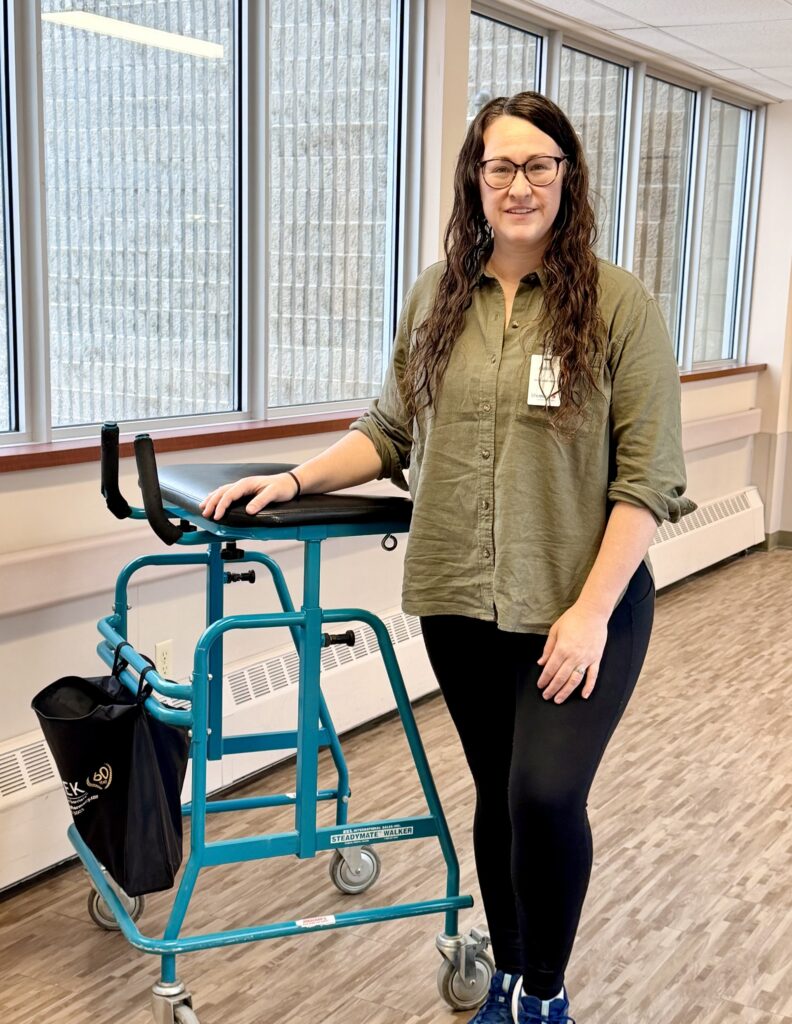
However, a long-term care opportunity was presented to her shortly after graduating her physiotherapy program, and Ashley courageously took a leap of faith and ended up in a sector where she finds meaning, fulfillment, and personal and professional growth. Ashley’s work in long-term care challenges common misconceptions about the sector and demonstrates the profound impact physiotherapists can have on residents, families, and care teams.
Ashley explains that long-term care is often seen as a population with low rehabilitation potential, with many residents being admitted when their mobility has plateaued or they are not able to return to community living. However, “that doesn’t mean there isn’t value in rehabilitation in the LTC environment,” Ashley says.
Ashley reminds us that long-term care residents still are motivated and have goals to be as independent as possible. Physiotherapists can make a meaningful difference by focusing on restorative function.
Ashley shares examples of residents who benefit from the power of focused physiotherapy. She spoke of a resident who had a goal of spending Christmas at his daughter’s home, which required completing steps into and out of the house.
“Six months prior to this goal, this resident required a mechanical lift to transfer, unable to stand. With his persistent work, as a team we were able to progress his mobility to where he successfully went to his daughter’s for Christmas,” Ashley says.
Another resident, who had not walked in six months following a long hospital stay, was able to walk with the physiotherapy team in just eight weeks. “That freedom has positively impacted her and her everyday life,” Ashley adds. Ashley notes that these outcomes are not just clinical milestones, rather, they are meaningful changes that affect how residents live day to day.
Ashley explains that working in long-term care forces physiotherapists to think outside the box and consider overall functional impairment.
“We do address acute injuries such as fractures, sprains, and strains as one would in outpatient settings” Ashley says, “but we are treating those acute injuries in the context of multi co-morbidities.”
She describes how a simple injury can have wide-ranging implications, from changes in transfer status to increased fall risk and the need for new mobility supports.
Physiotherapists in long-term care also work closely with other support teams to foster safe improvement of mobility. Ashley explains that collaboration with Behaviour Support teams, family education, and the use of Montessori-style activities can support therapeutic engagement and improved outcomes.
Ashley has found opportunities to expand physiotherapy roles beyond direct care. She is involved in fall prevention committees where she provides clinical expertise to improve programming and equipment distribution for nursing staff, while also analyzing trends in fall data. Furthermore, with limited occupational therapy support, physiotherapists in long-term care often take on expanded responsibilities as Assistive Device Program prescribers. “My wheelchair seating, and prescriptions of manual, tilt and power wheelchairs have expanded past knowing how one moves the wheelchair” Ashley explains. “Being able to prescribe a wheelchair effectively for pain relief, comfort to participate in daily activities, meet any specific needs of contractures and prevention/healing of pressure injuries can be very challenging but rewarding.”
In addition to mobility and restorative work, Ashley says physiotherapists bring strong diagnostic skills and the ability to assess urgent versus non-urgent needs for emergency care or imaging. They also consider medication timing and broader health factors when working with complex conditions.
Ashley explains that physiotherapists offer a holistic perspective, supporting not only function and mobility, but also pain management, participation in daily activities, and comfort through end-of-life care.
For Ashley, one of the most rewarding aspects of working in long-term care is being part of a resident’s end-of-life journey, whether that spans years, months, or days.
“Quality of Life goals over the last years of someone’s life are so important. Although we may not be achieving a high-performance level, being able to brush their hair, feed themselves, transfer with less assistance is life changing to residents and their families.”
At the same time, she acknowledges that long-term care work can be particularly challenging. Working with residents who have dementia or cognitive decline can make it difficult to implement therapeutic programs, and understanding each person’s story is essential to engagement and success. Ashley also highlights the emotional complexity of supporting residents and families through grief and loss, which requires strong communication and trust.
Ashley encourages physiotherapists and students to explore long-term care, even if it is not their intended career path. “I would highly recommend doing a placement in LTC if it’s available in your catchment” she says.
“Even if the plan is to focus in a different area of physiotherapy after graduation, I’ve had many students who have learned valuable communication techniques in challenging populations, who learn to think about the whole person and not just the one acute issue and also learn more about the complex chronic disease populations.”
For those considering leadership roles, Ashley says, “You don’t need a specific ‘Leader’ role to be a leader in your career. Be a team player and be a collaborator with all healthcare team members. By working together, your therapeutic outcomes will be more effective.” She adds that exploring different practice environments can help physiotherapists find the right fit and open doors to future opportunities.
Do you want to be featured? Are you in an innovative role? Spoken about physiotherapy in a podcast or the news? Published an article? Or represented the physiotherapy profession through advocacy?
We want to celebrate you as a physiotherapist, PT or PTA student or PTA!