skip to content

The Challenges and the Opportunity  

In 2026, internationally educated physiotherapists (IEPTs) represent 35% of all registered physiotherapists in Ontario. They are essential to Ontario’s physiotherapy workforce. Many IEPTs have successfully transitioned to physiotherapy practice in Ontario. They make significant contributions to the profession, from clinical roles, to administration, and research, and their contributions are vast and varied. 

However, through various consultations, OPA came to understand that the IEPT journey, from immigration to professional registration, to employment and practice, can be quite challenging. The transition to practice has many layers, from adjusting to a new country and language (for some), to adapting to new professional requirements and a new health care system.

OPA Launches Survey

In response to these identified challenges, OPA set out to better understand the professional journey, workforce integration experience, and workplace challenges, through a survey. We collected quantitative data and open-ended questions from Ontario’s IEPTs. OPA partnered with the College of Physiotherapists of Ontario (CPO) to promote broad dissemination of the survey through a variety of channels.   

The Response from IEPTs  

Between June 19, 2026, and July 24, 2026, 529 IEPTs completed the survey, representing more than 10% of Ontario’s IEPT population.  Respondents reported being trained in: 

  • India (65%) 
  • UK (7%) 
  • Australia (2%) 
  • United States (2%) 
  • 23% reported “Other”  

70% of respondents had been practicing for 3 years or less in Ontario, with more than half having less than 1 year of experience. 

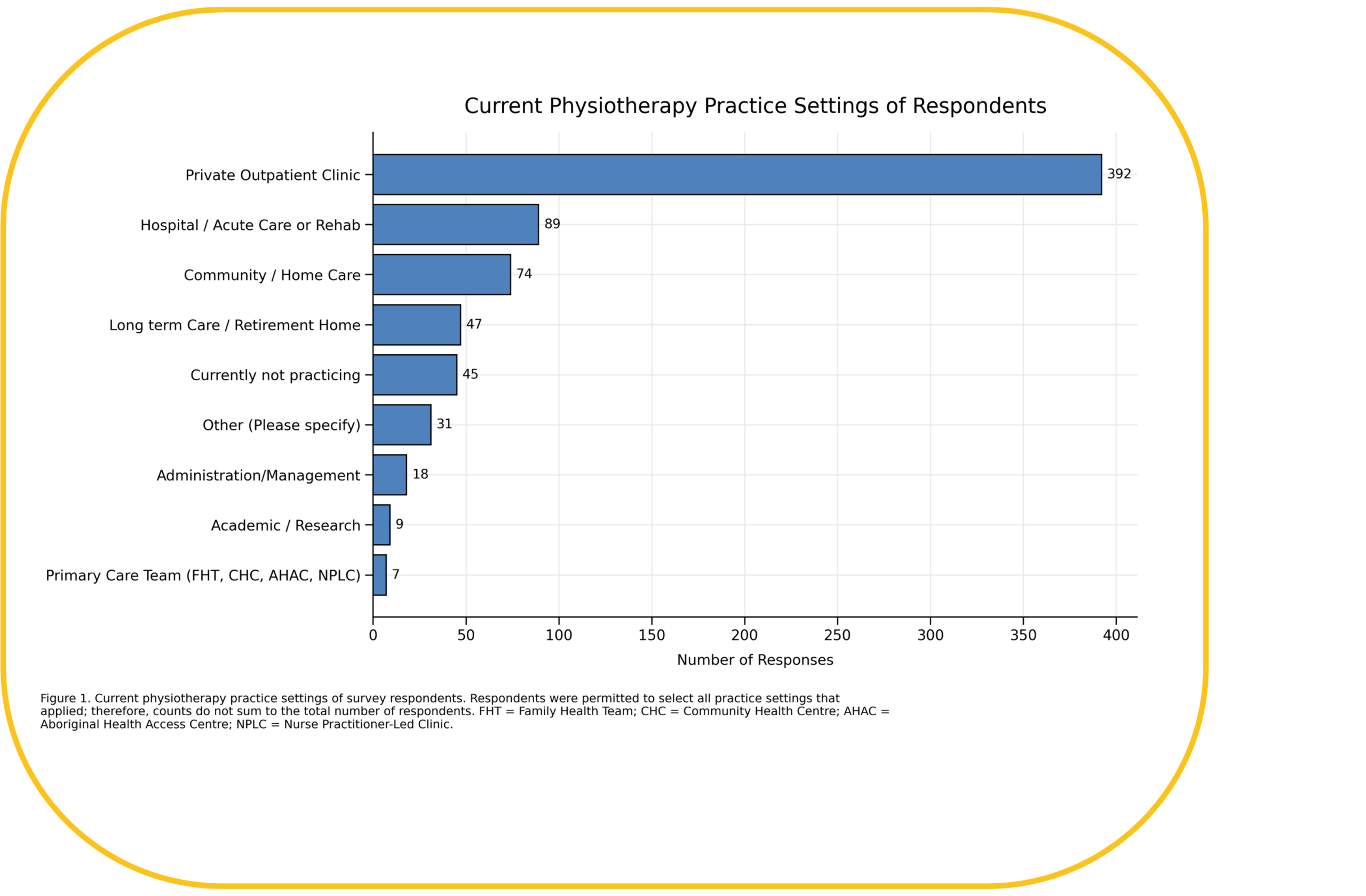
Most respondents work in private outpatient clinics (74%), followed by acute care and rehabilitation (17%), and home care (14%). The remaining respondents reported employment experience in areas of long-term care, administration, academia and primary care teams. (Figure 1).  

Figure 1. Self-reported practice settings by survey respondents (n=529) 

Internationally Educated PTs Practice Settings in Ontario chart

Key Outcomes and Themes 

Analysis of both the quantitative and open-ended responses from the survey identified four main themes. 

1. Physiotherapist licensing in Ontario is perceived as lengthy, expensive, and difficult to navigate for IEPTs 

Licensing costs, credentialing reviews, examinations, and varying timelines were frequently cited as barriers to registration. Respondents also described challenges accessing clear information on requirements and exam preparation. 

“Overall, the transition to practice was much more challenging than expected.” 

“Expensive cost for the process of getting licensed.” 

“Too many steps and procedures, long process.”

2. IEPT Bridging programs appear to improve readiness for physiotherapy practice 

Respondents who completed bridging programs report smoother adaptation to Canadian practice. Nearly half of respondents (45%, n=239) identified CPO and bridging program guidance as the most valuable topic for OPA workshops and resources. 

“A stark difference between people who underwent Ontario International Educated Physical Therapy Bridging Program at UofT [and those] who did not, in adapting to and exploring various subcategories of PT career in Ontario.” 

3. Workforce integration challenges persist after licensure for IEPTs 

Respondents frequently reported employment challenges related to inconsistent work hours, compensation, workload, and completing documentation outside paid work hours. Some respondents noted that available employment opportunities did not align with their personal or professional values, contributing to feelings of dissatisfaction within the profession. Nearly one-third of respondents (32%, n=169) identified finding employment and navigating the recruitment process as one of their top three challenges when entering practice in Ontario. They cited knowledge gaps around practice settings, job expectations, and employment conditions. 

“Finding reliable employment.” 

“Finding full time working hours in private outpatient…Not getting paid for documentation from any employers.” 

4. Ontario practice systems remain difficult to navigate for IEPTs after registration 

Respondents identified the need for additional supports and training in understanding expectations related to the patient-clinician relationship, including: 

  • communication norms
  • trust-building 
  • consent
  • and shared decision making

266 respondents (50%) reported that, “Adapting to the Canadian healthcare system and patient expectations” were one of the top three challenges they faced since beginning practicing in Ontario. 

“I did not know where to start finding someone to answer my questions… and I’m from Ontario.” 

“Ethical rules, standards and resources that are different.” 

Next Steps for OPA 

OPA is turning the survey findings into action. The results of the survey have identified several opportunities to further engage with, and support, IEPTs who are transitioning to practice in Ontario. Importantly, 71% of respondents were not OPA members, and 62% were unaware of the services and support that OPA provides. This signals both a need and an opportunity to strengthen connections with IEPTs, with this survey engagement project being an important first step. 

Pathway to Licensure and Preparatory Training 

At the time of survey distribution and data collection, support resources for licensure preparation were largely limited to private preparatory courses, exam blueprints, and Canadian Alliance of Physiotherapy Regulators (CAPR) practice examinations. Since the survey closed (July 2026), CAPR has announced the development of a free CPTE preparatory course, available through a CPA student membership. This initiative may address barriers identified in the survey results. However, follow up evaluation would be required to determine if there is a significant improvement in the overall perspective. 

Additionally, CAPR has released the new Comparability Pathway, with accompanying resources to help support the road to licensure. OPA will continue to monitor the impact of these tools, while also identifying the opportunity to collaborate more closely with CAPR to promote early access to OPA member supports, as IEPTs go through the licensing process. 

Physiotherapist Practice Supports 

The challenges identified in relation to practice transition are often not unique to IEPTs, specifically, with respect to understanding employment opportunities and navigating the often-complex landscape of physiotherapy service delivery in Ontario. 

For this reason, OPA is exploring opportunities to provides supports that would meet, not only the identified needs by IEPTs, but also challenges experienced in the student to new grad transition in Ontario, and across the general membership, including: 

  1. Establishing opportunities for mentorship, whether in group or individual formats.
  1. Developing resources to support navigation through the public and private healthcare landscape in Ontario, including various funding models, such as WSIB, MVA, etc. 
  1. Expanding OPA’s existing resources on finding and evaluating job opportunities for physiotherapists in Ontario. 

The development and implementation of these opportunities will occur over the next several months. Be sure to stay tuned for future developments. 

Thank You to Survey Respondents 

OPA would like to extend a sincere thank you to all physiotherapists who responded to the survey. Your contributions have been invaluable in identifying opportunities for OPA to better support IEPTs. 

This work will not only support IEPTs in their journey; it will support some of the profession’s core priorities, including access to care, quality of care, workforce sustainability, professional standards and member support. Helping IEPTs integrate effectively into the Ontario healthcare system strengthens the entire physiotherapy workforce. 

For additional information on this initiative, please reach out to the Practice and Policy Team at OPA. 

Details

Date

September 18, 2026