skip to content

2026 OPA Board Nominations – All PT Members Welcome! 

Group of diverse people looking pleased to meet in a board room.

Why You Should Consider Applying for OPA’s Board of Directors

Board Directors’ contributions to OPA are invaluable. They devote time, passion, and energy to guide the Association and the members OPA serves. At least five times a year, they gather to consider what OPA has accomplished, what is happening in the environment, and where to go next. They are actively engaged with OPA’s districts and committees to understand the priorities and issues of the profession.

Benefits to Being on the Board  

What may not be highlighted as often are the benefits to Board Directors personally and professionally in taking on this role. We see and hear every year how much Board members learn, grow, and get more connected by participating on the Board. Directors often run for additional terms, which means they can volunteer for a total of six years. And they choose to do so!

Board Directors’ Impact 

Collectively, the Board takes a global approach to planning, ensuring that all sectors and areas of the province across physiotherapists’ career span are included. They also evaluate environmental factors and consider both long-term and short-term planning. For example, advocacy for full scope of practice implementation has been relentless and ongoing for years. However, the pandemic led to a shift in priorities so that members had the support and advocacy they needed at that time. 

Every Director Brings an Important Perspective 

Every Board member’s contributions as individual PTs benefits all members. From highlighting nuances in rural and remote areas, to considering the different experiences of internationally educated PTs, the diversity of our Board members is critical for leading and shaping a well-rounded plan each year. Every year, new perspectives are incorporated from new Directors, and the Association grows in their collective knowledge! Maybe there’s an issue that only you have thought about that might impact physiotherapists in the future?

Reach out to Current Directors and OPA Staff 

Past and current Directors may have initially doubted their qualifications or readiness. Or they may have wondered about the benefits of taking on this role. Some spoke to existing Board members or reached out to OPA staff to find out more before applying. These options exist for you as well!  

We want you to consider how you would make a difference and what you would gain from the experience. We know that each and every one of you has something to contribute. 

About Board Nominations for 2026 

In keeping with our commitment to equity, diversity and inclusion, the Ontario Physiotherapy Association strives for a Board of Directors representative of its membership across the province and inclusive of diverse voices, practice experiences, and perspectives.  

All interested candidates are encouraged to apply. OPA is seeking individuals who bring their experience in rural and remote communities and/or work in public sector roles (hospital, primary care, home & community). 

More about the Role of the OPA Board of Directors 

The Board serves as the decision-making body providing strategic direction and oversight for the Association. Board meetings are held both in-person and virtually. 

Four Director Positions Open for Election in 2026 

The OPA Governance Committee is seeking candidates for four Directors. The election will be held at the 2026 Ontario Physiotherapy Association’s Annual General Meeting (AGM) on April 30, 2026 virtually.   

As per OPA Bylaws, no nominations from the floor at the AGM can be accepted. Therefore, those interested in being on the Board must submit their completed applications by Friday, February 27, 2026. 

Only OPA physiotherapist members are eligible to serve on the Board of Directors. 

Are You Interested? 

Find out more about what you need to do to apply. Questions? Contact Sarah Hutchison, OPA CEO at shutchison@opa.on.ca.  

Working Toward Fees and Salaries that Reflect Your Value

graphic showing a computer with online survey and other work tools including coffee

Help Shape Fair Compensation for Ontario Physiotherapists

The Ontario Physiotherapy Association is launching our 2026 compensation and fee surveys to ensure physiotherapist earnings across all sectors reflect the true value and scope of the profession. Our last comprehensive surveys were conducted in 2022, and a lot has changed in healthcare and the broader business landscape since then. 

Your input directly impacts fee negotiations with the Ministry of Health, private insurers, WSIB, and auto sector stakeholders. The more responses we receive, the stronger and more representative our market research becomes. It takes just a few minutes of your time. 

Why Your Input is Critical  

These surveys gather an accurate picture of what physiotherapists earn and charge across hospital, private practice, home care, primary care, and long-term care sectors. This data informs our Fee Guidelines and strengthens our advocacy with government and industry partners. It is the foundation for demonstrating the real value physiotherapists bring to Ontario’s healthcare system. 

Bonus: Your Feedback on the Ontario Physiotherapy Association 

We have also included questions about OPA membership in these surveys, open to OPA members and non-members. With this feedback, we ensure that the Association delivers real value to all physiotherapy professionals in Ontario. 

Complete the survey by January 30, 2026 

If you work across multiple sectors, complete all relevant surveys.

Please share this with your network. These surveys are open to both OPA members and non-members. 

Brian Pearce: Optimizing Impact in Primary Care

Physiotherapist Brian Pearce in a primary care team setting

Brian Pearce is a Registered Physiotherapist at Parkdale Queen West Community Health Centre in downtown Toronto. With 11 years of experience as a physiotherapist, Brian has worked in private outpatient orthopedics and hospital settings, with the most recent seven years spent working in primary care.

Team-Based Care and Scope Optimization 

Brian’s move into primary care was motivated by a desire to practice within a more integrated model of care. In private practice settings, he notes, physiotherapists often work with limited clinical information about the patient. Working within a primary care team enables shared access to medical records, including medical histories, medication lists, diagnostic imaging and laboratory reports, and hospital and specialist consult notes.  All of these medical reports help to inform assessment, diagnosis and management.

“You’re not privy to a lot of information when you see a patient in private practice,” Brian explains. “It’s really interesting to have the opportunity to work within a primary care team where you have all this information at your disposal.”

This access promotes real collaboration within the team and enables a broader role for physiotherapists who contribute to comprehensive care planning and management of patients.

Brian says that working in the same location as other primary care providers has allowed him to develop a strong sense of trust with his team members. “A lot of times it’s just having those informal water cooler conversations about a patient that we’re co-managing. Often it’s through those informal discussions that other providers really understand your thought processes and competencies as a clinician.

Those conversations have led to the creation of a medical directive for Brian to order x-rays and ultrasounds which has been in place for three years. Brian’s physician colleagues would like to see an even broader scope of practice for physiotherapy, including joint injections. Brian notes that having medical directives in place promotes all around efficiency – for both the patient and providers.

Musculoskeletal Care and First Contact 

Brian indicates that most of the care he provides is orthopedics, however, he identifies the common overlap with chronic disease management. He identifies, for example, the connection between metabolic diseases including obesity, dyslipidemia, hypertension, type 2 diabetes, and osteoarthritis and tendinopathy. In his role he works to support the client holistically. 

When a client accesses physiotherapy directly (ie. a first contact role), Brian observes that patients don’t see their family physician or nurse practitioner as often for that condition.  He notes about his physician colleagues: “A lot of times in one visit they’re dealing with five or more different problems that their patients are coming in for. They have a chronic COPD exacerbation and then they’re talking about their diabetes and then somewhere during their visit they bring up their back pain and knee pain or maybe they’ve got polyarthritis in their hands. So, if I’m able to take on a more central role in managing our client’s MSK concerns, I’m pleased to help take that burden off the shoulders of our GP and NP colleagues.”

Brian has expanded his role in primary care even further by completing his training with the Advanced Clinical Practitioner in Arthritis Care (ACPAC) program. The ACPAC program provides post-licensure training for health care professionals to independently assess, diagnose, triage, and manage rheumatic and musculoskeletal diseases. Brian tells the story of a patient who he suspected had rheumatoid arthritis. “Through the training I received with the ACPAC program we were able to order the appropriate blood work and diagnostic imaging studies which indicated that inflammatory arthritis was high on the list of differential diagnoses. As a result, this client was seen by the Rheumatology team at St. Michael’s Hospital within 3 weeks where he was formally diagnosed with rheumatoid arthritis.  

Care Across the Lifespan 

Primary care is fundamentally oriented toward continuity says Brian “I think of what primary care is, and its longitudinal care over the lifespan,” he says. Patients may be followed for extended periods, particularly those managing chronic pain, functional decline, or complex health conditions which provides a unique opportunity for patient support.

This long-term focus helps redefine expectations around physiotherapy outcomes. “Any real physical change someone would demonstrate through exercise or other interventions…you’re going to appreciate that more over a longer time frame,” Brian notes. He explains that for chronic disease management, a consultative model, with check ins every 2 to 3 months, can be helpful for longer term support.

Physiotherapy Service Model 

Brian reports that he typically sees 7 to 10 patients in a day, depending on the number of assessments and follow ups in a day. Although there is no set number of sessions per patient, Brian must balance the demand for service. He accomplishes this by focusing on active rehabilitation strategies, with a strong focus on patient education and self-management. This model allows for the right amount of care to be provided according to the presenting problem. Some patients require more, some less, but on average patients are seen for 4 to 5 physiotherapy sessions in Toronto area Community Health Centres. For Brian, impact is measured by whether physiotherapy supports his patients in managing their health more effectively over time.

The Time is Now  

The Ontario government is currently making significant investments in expanding team-based primary care through the Primary Care Action Team. Brian’s work illustrates how physiotherapists are essential to promote access to effective and efficient primary care for the management of musculoskeletal conditions. Full implementation of physiotherapy scope will only contribute to improved patient access, faster diagnosis and improved health outcomes.

For more information about physiotherapy in primary care, please see: 

Are You our Next Member Spotlight?

Do you want to be featured? Are you in an innovative role? Spoken about physiotherapy in a podcast or the news? Published an article? Or represented the physiotherapy profession through advocacy?

We want to celebrate you as a physiotherapist, PT or PTA student or PTA!
OPA 2026 Vision: The Future of Physiotherapy in Ontario

Person jumping showing inspiration

As we move into 2026, we share an extraordinary degree of optimism for the physiotherapy profession. We believe it will be recognized and valued even more for the impact we have on function, health, and well-being.

Physiotherapy helps people across their lifespan, wherever they access health care in the system.   

Our mission at OPA is clear. We are here to Support our members through advocacy, professional development, and career support. We Influence and shape decisions that affect the profession. We Empower our members to provide the utmost in safe and high-quality care to all people and communities we serve.   

As your provincial professional association, we recognize both the honour and the importance of representing your voice. Working with the Ontario government and key decision-makers, we represent you on the issues that matter most to you. Our focus is on the policies, funding decisions, and structures that affect your work every day and your patients.   

As we head into the New Year, we are set on achieving progress in the following areas:   

A Thriving Workforce and Practice Settings  
Our priorities include:  

  • Continuing our efforts to advance scope implementation  
  • Supporting the development and appropriate funding of physiotherapists in first contact primary care roles 
  • Advancing the Community Physiotherapy Clinic program in 2026 with a focus on program awareness, expansion and appropriate compensation  
  • Refining our 2026 OPA Fee Guideline with sector-specific information  
  • Working with FRSA (Financial Services Regulatory Authority of Ontario) and the Ministry of Finance to make long-overdue compensation changes 

Health System Transformation  

We are supporting physiotherapists and their teams by: 

  • Promoting interprofessional team-based care 
  • Advancing physiotherapists’ participation in health system transformation with a focus on Home and Community Care and Long-Term Care 
  • Making it easier to deliver informed patient care by gaining access to provincial digital assets (Diagnostic Imaging Repository, OLIS – Ontario Laboratories Information Systems)  

Our Membership 

We are most successful with your involvement and partnership. This is why OPA listens to and engages students, new graduates, PTAs, and physiotherapists throughout their careers. Our volunteers on committees, district executives and our Board of Directors make sure our work is relevant and positively impactful. We couldn’t do this without you.   

Transparent and Inclusive 

The processes and supports we develop matter. We continue to make them more accessible, inclusive, and transparent. We celebrate our wins, share progress with our members regularly and invite you to participate at any time.  

As we move into 2026 and our bold initiatives, reflecting on the successes of 2025 provides us with confidence and a roadmap for moving forward.  Thank you for your support and confidence in us – together, we can accomplish so much more!  

Sincerely,

Sarah Hutchison, CEO & Courtney Bean, President  

Courtney Bean, OPA President’s Year End Message for 2025

OPA’s President, Courtney Bean, reflects on key wins for 2025.

He celebrates the strength of Ontario’s physiotherapy community, thanks volunteers, and all the physiotherapists, physiotherapist assistants and student members for their contributions. Courtney also acknowledges the many connections OPA maintains with health care leadership, other associations and organizations that help drive our advocacy initiatives forward.

Watch his video now!

Happy Holidays to all and we look forward to an exciting 2026! 

What We Have Accomplished This Year

Group of five diverse business people indicating success, with their hands up.

We are excited by all that OPA has accomplished this year on behalf of our members and the profession overall. While advocacy never really stops, we are taking a moment to reflect on our successes.

1. Significant Progress on Scope of Practice Implementation

The Government of Ontario announced plans to implement regulations allowing physiotherapists to order diagnostic imaging (X-rays, CT scans, MRIs, and diagnostic ultrasounds). OPA’s relentlessly advocated through:

  • Ongoing meetings with the Ministry of Health 
  • Meetings with the Premier, Minister of Health and MPPs across the province with our members 
  • Submitting detailed scope of practice submissions 
  • OPA’s CEO presenting to the Standing Committee on Finance and Economic Affairs on Bill 2, showing the importance of scope implementation to keep pace with other provinces and increase labour mobility. 
  • Building relationships at Queen’s Park, including meeting with Premier Doug Ford and Deputy Premier and Minister of Health Sylvia Jones. We also met with MPP France Gélinas, Physiotherapist, who spoke about scope of practice implementation in the legislature.
  • Writing letters for member’s meetings with Premier Doug Ford and Minister of Health Sylvia Jones 

We hope to see movement on the scope of practice implementation in 2026! 

2. Advancing Physiotherapists’ Role in Primary Care: OPA successfully advocated for physiotherapists to be recognized in Ontario’s Primary Care Action Plan. We: 

  • Received a letter from the Deputy Premier & Minister of Health and Dr. Jane Philpott as the Chair of the Primary Care Action Team. We were pleased to see the recognition that Primary Care Teams should be made up of family physicians or nurse practitioners along with nurses, physician assistants, social workers, physiotherapists and other health care professions.   
  • Presented at multiple primary care conferences. OPA staff shared the evidence that PTs on interprofessional teams can increase patient attachment rates by approximately 425 rostered patients (24%), particularly important since 20-30% of primary care visits involve musculoskeletal conditions. 

3. Strong Member Engagement, Education & Resources: OPA hosted successful events and provided members with helpful resources. This included: 

  • OPA’s InterACTION conference with over 300 attendees 
  • Northern Ontario District’s conference Physio North 2025, inspiring attendees and providing them the opportunity to network
  • An Understanding and Navigating Auto Claims Guide

4. Recognition and Award-Winning Communications: OPA’s communications and marketing continue to expand and reach new audiences with effective strategies. 

  • Our “New Voices, New Ideas & New Opportunities” campaign won multiple prestigious awards including a Silver Telly Award and three gold Healthcare Digital Marketing Awards. We effectively showcased the association’s evolving leadership and value to members. 
  • We also launched a bold new website which is easier to navigate and is a reflection of OPA’s commitment to transparency and accountability. OPA’s new website and its key features were driven by members’ feedback and drove every decision. 

5. Equity, Inclusion and Diversity Commitment: OPA continues its commitment to have equity, inclusion and diversity embedded into everything we do.  

  • OPA developed a position statement advocating for improved Jordan’s Principle processes. With Indigenous Services Canada committed to reforming the administration, OPA is pushing for:  
  • Reduced systemic barriers that prevent access to physiotherapy services  
  • Culturally safe service delivery with collaborative community co-design  
  • Continuity of care through longer-term contracts with trusted partners  
  • Increased administrative capacity with transparency to address backlogs  
  • Recognition of physiotherapy as essential preventive and early intervention care 

Support the advocacy work we do on behalf of the physiotherapy community in Ontario. Join OPA/CPA!

Advocacy at OPA’s Fall Primary Care Advisory Committee 

Quarterly Meeting 

The Primary Care Advisory Committee met on October 9, 2025, and focused its advocacy discussions on: 

  • Promoting fair compensation for physiotherapists across sectors 
  • Supporting the integration of physiotherapy into primary care through new and repurposed roles 
  • Education opportunities to improve physiotherapists’ understanding of Ontario Health Team models 
  • Opportunities to help physiotherapists navigate diverse care and funding models within primary care 
  • Networking, engagement, and collaboration opportunities to help connect primary care physiotherapists 

Join the Primary Care Advisory Committee 

The Primary Care Advisory Committee is made up of volunteer members who advise OPA staff and the Board of Directors on issues affecting physiotherapy in primary care settings. 

This committee supports members and promotes quality physiotherapy services within primary care organizations across Ontario. 

Interested in joining? We welcome new volunteer members who want to help shape the future of physiotherapy in primary care. Contact us a physiomail@opa.on.ca

OPA Staff Present at AFHTO 2025

Physiotherapists are essential in Primary Care Teams  

OPA continues to advocate for increasing the integration of physiotherapists into primary care teams. Emily Stevenson, OPA’s Director of Practice & Policy and Amy Hondronicols, former OPA Director, presented at the Association of Family Health Teams of Ontario conference, Power of Primary Care 2025, on October 23. Emily and Amy shared the evidence for physiotherapists in team-based primary care – resulting in the right care, at the right time, by the right provider. 

Emily Stevenson
Amy Hondronicols, Physiotherapist and former Director, Practice and Policy at OPA. Amy is presenting at AFHTO 2025 conference on the value of PTs on primary care teams.
Amy Hondronicols

The Evidence Shows: 

  • Faster access to the right care 
  • Less diagnostic imaging ordered 
  • Fewer referrals to specialists (orthopedics and rheumatology) 
  • Less sick leave 
  • Fewer prescriptions for pharmaceuticals 
  • Higher patient satisfaction  
  • Low rate of follow up with Family Physician or Nurse Practitioner (<1% in the UK) 
Amy Hondronicols, Courtney Bean, Emily Stevenson, Honourable George Smitherman and OPA's CEO Sarah Hutchison at the Association of Family Health Teams of Ontario conference on October 23, 2025.
From L to R: Amy Hondronicols, Courtney Bean, Emily Stevenson, Hon. George Smitherman, Sarah Hutchison

Emily and Amy were joined by OPA’s President, Courtney Bean, and Sarah Hutchison, OPA’s CEO.  

 Helping Ontario reach 100% Attachment 

There are currently about 90 physiotherapist positions in primary care teams in Ontario, including Family Health Teams, Community Health Centres, Nurse Practitioner-Led Clinics, and Indigenous Primary Care Teams. With Ontario’s Primary Care Action Plan to create or expand 305 teams, there is great opportunity to increase the presence of physiotherapists to support Ontario’s goal of 100% attachment to primary care. 

First Contact Physiotherapy in Primary Care Teams 

The evidence is there – first contact physiotherapy improves patient outcomes, family physician/nurse practitioner satisfaction and reduces red tape within the health system.  

Physiotherapists are the experts in the assessment, diagnosis for all MSK concerns. With 20-30% of all visits to primary care in Ontario being musculoskeletal (MSK) concerns, physiotherapists can be the first contact, and offload visits from the family physician or nurse practitioner. It is estimated that an additional 425 patients could be attached per physiotherapist.  

The Family Physician/Nurse Practitioner Perspective 

88% of family physicians and nurse practitioners reported that working with a physiotherapist increased their own satisfaction in providing care. 94% reported that having a physiotherapist in the team resulted in more comprehensive care for the patients. (Toronto Community Health Centre Evaluation, 2016).

Resource for Physiotherapists in Primary Care Teams 

In their presentation, Emily and Amy also shared about the development of the PT in Primary Care Competencies and Educational Modules – an initiative in partnership with Team Primary Care (Projects — Team Primary Care | Équipe de Soins Primaires). This project was led by Dr. Jordan Miller and supported by the Canadian Physiotherapy Association. It included contributions from various physiotherapy professionals across Canada. 

The education modules are designed to support physiotherapists to successfully integrate into interprofessional teams in primary care. The modules are also helpful to educate interprofessional team members and team leadership/ executives – so feel free to share broadly with anyone in your local community/network! 

Physiotherapy in Primary Care Teams – Improving Health Outcomes 

The evidence shows that adding physiotherapists to primary care teams improves patient, provider, and system outcome in Ontario. The more we can demonstrate our value across all practice settings, the more we are able to advocate for increasing access so that everyone in Ontario has a physiotherapist across their lifespan. 

Physio North 2025 – Caring for Oneself – Big Success!

Rhonda Matthews, Northern Ontario District President of OPA, with an attendee from Physio North 2025.
Rhonda Matthews (L) with conference attendee

“I feel encouraged about our profession and am more motivated to get back at it!” – feedback from one Physio North conference attendee 

Northern Ontario District members welcomed the physiotherapy community to their district’s bi-annual conference in Timmins.  

The event took place over two days, from October 3-4, and included many amazing sessions, a pre-conference course, and a chance to network with the Northern and Northwestern Ontario physiotherapy community, among others. 

What a few attendees had to say about the event:  

 “It was truly a valuable experience for both skill development and networking opportunities. It was great connecting with so many engaged professionals.” 

 “Amazing coming together of the North.” 

 When asked what they liked most about the event, attendees shared: 
 
“Networking with colleagues, meeting/interacting with the CEOs of the CPO and OPA” 
 
“Networking with peers and sharing what is important to Northeastern Ontario Physiotherapists with OPA and the College” 

Craig Roxborough, Registrar & CEO and Mary-Catherine Fraser Saxena, Manager, Practice Advice (CPO) both echoed there were lots of meaningful conversations, and they appreciated the opportunity to connect with PTs in the North to hear their perspectives.

Courtney Bean, OPA’s President, said he had such a great time and it really filled his bucket. He said he has some good understanding of the challenges of rural care but now realizes the amazing passion of people providing care in rural locations. He also learned a lot about care in the North…a lot more than he ever knew. 

Sarah Hutchison, OPA’s CEO, gained a deeper appreciation of the challenges that rural and remote physiotherapists face and how the OPA might advocate further. She also observed that the sense of community was incredible and contagious!  

Northern Ontario District of OPA's Physio North Speakers, Jack Miller, Courtney Bean, OPA's President, and Sarah Hutchison, OPA CEO
From L to R: Jack Miller, PT & Pre-conference Course Instructor, Courtney Bean, PT and OPA President & Sarah Hutchison, OPA CEO

Get Involved Locally 

Physio North 2025 is one example of the amazing work done by district volunteers. Thank you to Rhonda Matthews, Northern Ontario District President, and Jody Lemieux, Secretary, for making this event happen! 

Regional representation at OPA through our 16 districts is invaluable. While districts may share similarities, understanding the unique populations and advocacy needs in each district contributes to OPA’s success. We encourage all members to get involved in their districts.  

Are you in Durham, Niagara or Northwestern Ontario Districts? 

OPA is currently looking for member volunteers in these districts. Contact Prerna at ptawde@opa.on.ca if you are interested in volunteering. 

Thank you to our Exhibitor, Motion

Logo for Motion, a Canadian provider of comprehensive and customized mobility and home accessibility solutions

PTs Play an Important Role in Team-Based Primary Care 

OPA Presents at Health Workforce Canada Connects Conference 

Krissy Bell, CPA's CEO moderating session in which Emily Stevenson, OPA's Director, Practice & Policy shares the importance of having PTs in team-based primary care

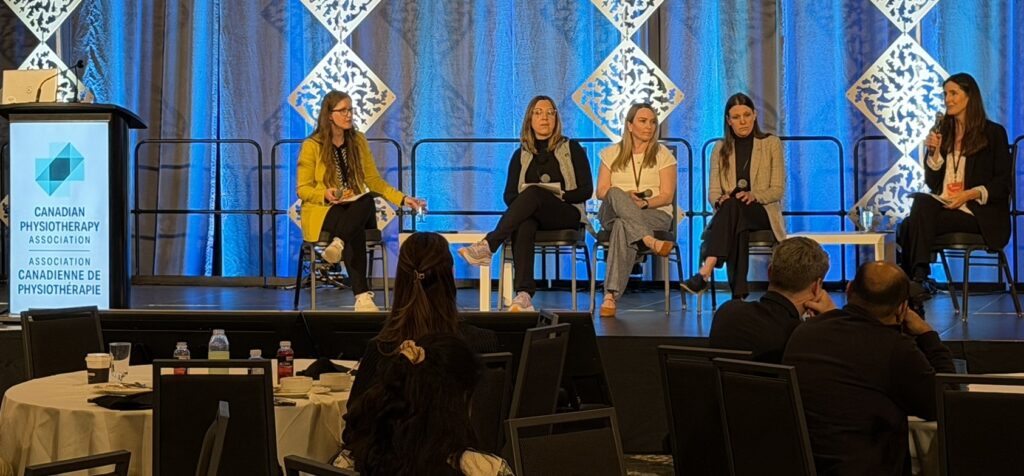
Emily Stevenson, Director of Practice and Policy at OPA, spoke at the Health Workforce Canada Connects conference about the value physiotherapists bring to primary care teams. CPA CEO Krissy (Murphy) Bell moderated the workshop “From Silos to Synergy: Scalable, Sustainable Solutions for Team-Based Primary Care”. The session brought together an exceptional panel of leaders from across a diverse spectrum of professions, perspectives, and places in Canada to explore scalable and sustainable models for team-based primary care.

Physiotherapy Access in Primary Care Matters  

Emily Stevenson highlighted how critical it is that PTs are incorporated into health human resource planning as they are essential members of team-based primary care. Physiotherapists, when incorporated, increase access and attachment to primary care, as they can assess, diagnosis and treat conditions in their scope, which increases the capacity of family physicians and other team members. Physiotherapists need to be part of every primary care team to provide the right care, at the right time, by the right person. 

Roles for PTs in Primary Care 

We know that PTs in primary care:

  • improve access to health services
  • work collaboratively with other providers to build more capacity in primary care teams
  • reduce emergency department visits
  • lead to better outcomes for patients   
  • and enhance continuity of care for patients.

In 2015, OPA was one of the strong advocates leading to the addition of PTs to Family Health Teams in Ontario.  

Visit OPA’s Primary Care Hub to stay up to date on all things primary care. 

The Impact on All Physiotherapists

Presenting at national interprofessional conferences allows OPA to demonstrate the value we bring to patients and health system partners. It provides us an opportunity to connect to other health care professionals, building relationships for increased collaboration and advocacy. Thank you to CPA’s CEO, Krissy Bell, for inviting OPA to participate in this important panel discussion. 

What is Health Workforce Canada? 

Health Workforce Canada is a new, independent organization established by an Interim Steering Committee, supported by the Canadian Institute for Health Information (CIHI), and funded by Health Canada. It has been created in recognition of the need to bring together health workforce experts and those in the health care field to learn from each other and strengthen health workforce data and planning to help ensure health workers are there to provide the care people in Canada need. 

Thank you to the Health Workforce Canada | Effectif de la santé Canada team for bringing together such an engaged community of health systems leaders and workforce planners, and for continuing to create space for collaboration and innovation. 

Resource for PTs in Team-Based Primary Care 

The Competency Profile for Physiotherapists in Team-based Primary Care in Canada and Preparing Physiotherapists for Team-Based Primary Care educational module series were created by a team of experienced primary care physiotherapists, other interprofessional primary care team members, people with lived experience as patients, and primary care academic experts.