About the Bundled Care Program
The Ontario Ministry of Health (MoH) implemented the Bundled Care Program for hip and knee arthroplasties in 2018 Under this initiative, a single payment is given to a provider to cover the costs of an episode of health care (i.e., from surgery to inpatient stay to rehabilitation) across multiple settings and providers. (Ontario Hospital Association Bundled Care). The Bundled Care Program was expanded in 2019 to included shoulder arthroplasties.
In this model, community physiotherapist clinics hold contracts to deliver the required outpatient rehabilitation care.The “Bundle holder” is the provider that receives funding from the MoH (typically the hospital where the surgery takes place), and the “Bundle provider” is the clinic or physiotherapist who holds contracts with the Bundle holder to deliver physiotherapy to patients referred through the program.
Ministry Program Review
The MoH invited OPA to participate as a key informant in an independent program review of the Bundled Care Program. The purpose of the program review is to identify strengths, challenges, and opportunities for improvement, and to support the Ministry in decisions regarding the program’s scope and long-term direction. The review is being completed by Nous Group Canada, an independent consulting firm.
Member Consultation
To inform the OPA’s contribution to the review of the Bundled Care Program, OPA provided two opportunities for members to provide feedback. Members were invited to complete an online survey, and/or to participate in focus group hosted by OPA. During OPA’s consultation with Nous group, Nous identified that it would be helpful to connect directly with individuals delivering the bundled care program. OPA facilitated the connection to members for a focus group
What We Heard and Shared
The survey was open from September 16 until September 28, 2026, with 43 respondents. There was representation across all six Ontario Health Regions, with most representation from the West (35%), followed by Central (26%). Most respondents were clinic owners who are “Bundle providers” (52%), followed by clinicians (30%) who deliver care within the bundled care program, and other respondents (18%) included clinic directors and managers who oversee services delivered within the Bundled Care Program. Five people also participated in the focus group hosted by OPA.
What is Working Well
- Access to Publicly Funded Care
The main strength of the program was identified as being access to publicly funded physiotherapy for all patients who undergo joint replacement surgery for the hip, knee or shoulder. Because there are limited options for publicly funded physiotherapy, the Bundled Care Program ensures that all patients who undergo an arthroplasty have access to some essential physiotherapy care.
- Local Access to Post-Surgical Rehabilitation
Respondents also noted that the Bundled Care Program promotes local access to care, since the program is delivered through local physiotherapy clinics which have an agreement with the Bundle Holder. and which the patient can choose from. Fair and reasonable choices based on geography was identified as a significant strength.
- Streamlined Referral Process
Lastly, most respondents identified that the referral process from the “Bundle holder” to the “Bundle provider” was relatively seamless, with most receiving referrals via email, which promoted timely and easy access to care for patients.
What are the Issues
- Funding and Compensation
Respondents identified the funding model as the biggest limitation of the Bundled Care Program. When the program began in 2019, many “Bundle holders” set the rate of compensation for both hip and knee arthroplasty at $312, and although some contracts have evolved to upwards of $400 per procedure, many have not moved from the original fee. The current rate of $486 per shoulder arthroplasty is also highly variable across “Bundle holders”. The current funding model poses an issue on several fronts.
- Funding does not align with the recommended number of sessions per procedure. Knee arthroplasties are recommended to receive 12 to 14 sessions, while hip arthroplasties are recommended to received 4 to 8 sessions, but both are compensated at the same rate of $312 (see Table 1). When shoulder arthroplasties were added a year later, the compensation per procedure was higher at $486, but the recommended number of sessions per procedure falls between the recommended number of hips and knees, at 8 to 12 sessions. To support recommended provincial clinical best practices, the funding needs to reflect the amount of service, i.e., more sessions equal more funding.
- Funding has not kept pace with operating costs. The funding of $312 to bundle providers has stayed the same since inception of the program (2019), however operating costs for service delivery have increased every year, creating a widening gap between Bundled Care Program funding and current market rates for physiotherapy (see Table 1). There has been a slight increase for only some bundle holders, but the maximum reported by survey respondents was $400 per procedure and this is not consistent across bundle providers. Even at this rate, the gap with current market rates is making it increasingly difficult for “Bundle holders” to deliver the recommend services to optimize patient outcomes.
“The fees do not cover our physiotherapy costs, The minimal budget does not provide adequate coverage for the amount of physiotherapy post (surgical) outpatient need, and the current physiotherapy fee rates the physiotherapists charge and should be respectfully considered.”
Table 1. The gap between Bundle Care Program Funding and Market Rate Physiotherapy Fees
| Surgery Type | RCA Recommended Sessions | Current Bundle | Per-session equivalent Rate* | 30-minute Market Rate Average** | Rate Gap | Bundle Funding based on Market Rate*** |
| Total Knee | 12-14 | $312 | $22-$26 | $90 | 71-75% | $1080- $1260 |
| Total Hip | 4-8 | $312 | $39-$78 | $90 | 13-57% | $360 – $720 |
| Total Shoulder | 8-12 | $486 | $41-$61 | $90 | 33-55% | $720 – $1080 |
*Based on recommended number of sessions by the Rehab Care Alliance (https://rehabcarealliance.ca/wp-content/uploads/2026/04/TJR-Framework.pdf)
**Based on the Ontario Physiotherapy Association 2026 Market Rate Report
***For service delivery only; 30-minute rate; does not include completion of outcomes measures
- Funding agreements vary across Ontario. The variation in funding agreements among “Bundle holders” in the province has created discrepancies in access to publicly funded care. Although it was initially intended that “Bundle providers” could negotiate compensation with the “Bundle holders”, it is necessary to recognize that this has been nearly impossible due to the large power differential between hospitals with large operating budgets and small community businesses.
For clinics to participate in the program, and make care accessible to their communities, they have needed to accept insufficient compensation. It is necessary that there be standardized Bundled Care Program funding across the province, with regular adjustments for inflation and operating costs to deliver the program, to maintain access to care.
“The funding of $312 and an expectation to give 6 visits are unrealistic. We actually quit offering this service since the hospital would not negotiate a better plan with us.”
- Patient outcomes are impacted. Beyond access challenges, respondents to the survey identified the impact of insufficient funding on patient care. Rehabilitation is a spectrum – the goal is always to help patients meet their goals. However, this is not always possible within the funding model. The impact? Patients will have poorer outcomes. They have more pain, less mobility in their joint, and insufficient strength to participate in their daily activities, putting them at higher risk for loss of independence and falls.
“Too little funding, physiotherapists aren’t compensated well enough for the time it takes to rehab patients, or patients are discharged before they’ve met their major goals.”
“Funding does not reflect the level of care required to optimize post-surgical outcomes.”
This is especially true for more complex patients with higher levels of pre-surgical impairment – there is no mechanism on the current funding model to account for higher complexity and morbidity requiring more intensive rehabilitation.
OPA has also flagged that with the expansion of services through Integrated Community Health Services Centres, it is essential to ensure consistent funding approaches across settings. Furthermore, with an increase in same day surgeries, the hospitals costs are reducing providing an opportunity to reprofile the bundled care funding to rehabilitation.
- Invoicing and Payments
Respondents also identified challenges with invoicing and payments. Specifically, there are concerns regarding delays in receiving payments for invoiced services.
“Excessive delays in receiving payment on invoiced services for bundled care (currently payment is not received for 3-5 months after care if provided)”
Bundle providers also noted that every bundle holder has a different payment system – some via electronic funds transfer, and some via cheques. Bundle providers may hold contracts with different bundle holders which adds a significant amount of administrative burden.
“Dealing with all the hospitals, separate protocols, chasing them for payment, all the different criteria and paperwork that each one requires.”
- Communication
Respondents also identified that communication with bundle holders can be challenging, in particular when a patient requires readmission. It was also noted that consistently updated resources for clinics involved in the bundled care program would support access.
Recommendations to the Ministry of Health
OPA recommends that the Ministry of Health continue with the Bundled Care Program to ensure that patients continue to have streamlined access to publicly funded local rehabilitation services following joint arthroplasty. OPA recommends that the following be considered:
- Increase outpatient rehabilitation funding: Bring funding closer in line with current market rate physiotherapy fees. This will ensure program sustainability by ensuring operating costs are covered, and ensure patients achieve their rehabilitation goals.
- Align funding with recommended sessions: Base funding on the recommended session numbers in the RCA best practice guidelines per procedure
- Compensate administrative work: Include compensation for administrative costs of completing outcome measures and reporting in NACRs Clinic Lite
- Add risk stratification to funding model: Consider a mechanism for risk stratification of patients (ie. same day vs. inpatient); and ability to add additional funding when required by patient complexity and outcomes
- Standardize funding: Ensure a consistent model of funding across existing Bundle Holders and emerging Integrated Community Health Services Centres
- Streamline invoicing and reporting: Develop a central (or regional) agency/portal for invoicing and reporting. At minimum, develop standards for each bundle holder in terms of referral processes, invoicing processes, payment methods, and time frame for payment to clinics.
- Review outcome measure reporting requirements: Review the requirements for outcome measure completion and streamline where possible
Beyond Bundled Care: Ontario Needs a Musculoskeletal Strategy
Although beyond the scope of this current consultation, OPA took the opportunity to identify the need for a broader approach to musculoskeletal care in Ontario. The number of total knee arthroplasties and total hip arthroplasties has increased by 186% and 226% respectively – requiring a significant investment in healthcare dollars.
However, surgical intervention for the management of osteoarthritis (OA) is the third tier of treatment. The first- and second-line treatments of care are much less costly, and can divert and/or delay surgery, but are inaccessible to many in Ontario, due to limited public funding for physiotherapy services.
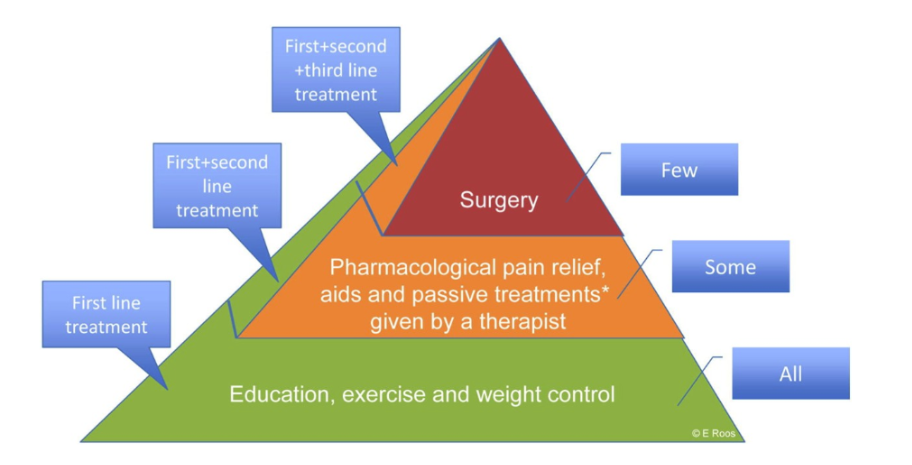
OPA recommends that while addressing the current funding shortfalls of the Bundled Care Program, the province would also benefit from a review of the overall management of osteoarthritis in the province to ensure the most cost-effective approach. Best practices for OA include first line treatment of education, exercise, and weight control. Although access to these front-line services in the public system are currently limited, the province is well poised to strengthen and expand on several existing programs to promote earlier access to non-surgical care, namely:
- Physiotherapists in Primary Care Teams
Expanding access to physiotherapists in primary care teams through the Primary Care Action Team funding, where physiotherapists can act as first contact providers, and support early diagnosis and non-surgical management of osteoarthritis.
- Provincial Hip and Knee OA Management Pilot
Expanding and increasing funding for the provincial pilot of the GLAD (Good Life with Arthritis Canada) Program, currently available in Toronto, Champlain and North West region.
- Community Physiotherapy Clinic Program
Increasing access to comprehensive musculoskeletal assessment and treatment through the Community Physiotherapy Clinic Program, promoting access to care for seniors, and for those in rural and remote communities.
Taken together, the strengthening of these programs will improve non-surgical care and management of OA and reduce the overall costs of surgical management. OPA strongly recommends that the Ministry of Health create a comprehensive provincial strategy for the management of osteoarthritis, including all three tiers of treatment.
What’s Next
OPA would like to thank everyone who contributed to our consultation regarding the Bundled Care Program. If you have any questions or comments, please reach out to Emily Stevenson, Director of Practice and Policy at estevenson@opa.on.ca. OPA is committed to sharing back any information from the outcomes of the Ministry of Health review.