skip to content

Member Spotlight: Becoming a Physiotherapy Officer in the Canadian Armed Forces 

A Career Pathway for Physiotherapists Seeking Leadership, Innovation, and Service 

In March 2026, the federal government announced new investments in Canada’s defence capabilities, including a significant increase in military personnel and operational readiness spending.1,2 While these announcements may not immediately bring physiotherapy to mind, they highlight a lesser-known and innovative career pathway available to physiotherapists interested in combining clinical practice and leadership, service, and professional growth.  

Lauren Robb, Physiotherapist in the Canadian Armed Forces
Lauren Robb
Kyle - Physiotherapist in the Canadian Armed Forces
Kyle Spenard

For Lauren Robb and Kyle Spenard, two recent physiotherapy graduates enrolled with the Canadian Armed Forces (CAF) Subsidized Education – Entry Level Master’s Program,3 becoming a Physiotherapy Officer offered far more than a traditional first job after graduation. It provided an opportunity to apply their physiotherapy education and clinical skills in a unique environment, work with highly specialized patient populations, and develop skills that extend beyond clinical practice.

The decision to join the CAF was more than a strategy to pay for graduate school. Their stories highlight how physiotherapists are finding innovative ways to build meaningful careers while helping meet the health and performance needs of the CAF. 

A Unique Clinical Population and Expanded Career Opportunities 

Physiotherapy Officers work with a diverse military population, including soldiers, pilots, divers, naval personnel, and other service members whose occupations place unique physical demands on their bodies.4,5 Supporting members of the CAF requires a physiotherapist to understand not only injury recovery, but also the operational requirements of military service. For Lauren, one of the most appealing aspects of military physiotherapy was the opportunity to practice in an environment that is unlike most civilian settings. 

“You might be treating a diver or someone in the Air Force or someone in the Navy, and they would all have very particular operational requirements.” – Kyle Spenard 

Both Lauren and Kyle were previously interested in treating athletic and high-performance populations which is now applicable to military personnel. Rather than focusing solely on traditional return-to-work goals, Physiotherapy Officers help military members safely return to highly specialized occupational roles. 

Lack of Funding Constraints Enables More Comprehensive Care 

Another meaningful difference between military and civilian physiotherapy is the ability to provide care without the same funding constraints that often shape treatment decisions in civilian practice. In the CAF, physiotherapy services are fully covered, allowing Physiotherapy Officers to base treatment frequency, duration, and follow-up on clinical need rather than on out-of-pocket costs, private insurance limits, or extended health benefits caps.

For many civilian populations, these extended health benefits limitations can affect how often patients attend physiotherapy and how long they are able to continue rehabilitation. Within the CAF, this creates greater opportunity to provide comprehensive, timely, and individualized care, supported by advanced equipment, longer appointments, and more consistent follow-up when clinically indicated. 

Confidence During the Transition to Independent Practice 

Graduating from physiotherapy school often brings uncertainty, as Kyle reflected. Licensing examinations, job searches, contract negotiations, and decisions about future career direction can create significant pressure for new graduates. For Lauren and Kyle, entering a clearly defined professional pathway with the CAF allowed them to focus on becoming excellent clinicians, while their peers were managing this transition to independent practice and securing a job.  

“That was not something I even needed to consider,” Lauren said when reflecting on the employment search process that many of her classmates were navigating. Kyle expressed a similar sentiment: “I could just focus on finishing, focus on studying for my CPTE exam.”   

A Structured Transition into Practice 

As entry to physiotherapy licensing continues to evolve in Canada4, new graduates are increasingly seeking opportunities for mentorship and supported professional development as they enter independent practice. The CAF pathway offers a structured transition-to-practice experience that is becoming increasingly uncommon in many healthcare settings.3,5 After graduating from their physiotherapy programs and completing basic military training, Lauren and Kyle will spend approximately a year working alongside experienced Physiotherapy Officers while participating in military-specific education and professional development. Lauren describes this experience as: “An amazing mentorship opportunity.” 

For physiotherapists who are passionate about lifelong learning, the CAF pathway provides opportunities to pursue advanced clinical education while working within a highly collaborative healthcare team.3,5 Kyle explained that military-funded courses include Advanced Integrated Musculoskeletal (AIMS) training, McKenzie Method Training, and dry needling and acupuncture. 

Building a Career Beyond Traditional Practice Settings 

One of the strongest themes that emerged from conversations with Lauren and Kyle was the importance of thinking broadly about what a physiotherapy career can look like. Many physiotherapy students are familiar with careers in private practice, hospitals, rehabilitation facilities, or community care. The CAF offers an alternative pathway that combines clinical care, leadership, education, and service.3,5 

Physiotherapy Officers may find themselves working across Canada, collaborating with diverse healthcare professionals, supporting military training programs, and contributing to initiatives focused on injury prevention, workforce readiness, and human performance.3,5 For clinicians interested in expanding their impact beyond individual patient encounters, these experiences can provide valuable perspectives on healthcare delivery and interdisciplinary collaboration. 

In many ways, the military pathway provides a structured transition-to-practice experience that many new graduates actively seek but may struggle to find in civilian settings. 

An Under-Recognized Opportunity for the Profession 

Perhaps the most surprising insight from both Lauren and Kyle was how few physiotherapy students appear to be aware of this pathway. They expressed surprise that more students had not explored CAF Physiotherapy Officer pathways given the combination of funded education, structured mentorship, specialized clinical experiences, career stability, and leadership opportunities. For students considering physiotherapy, Lauren encourages a long-term perspective. 

“The main thing is just considering your long-term goals, where you see yourself, where you want to be.” – Lauren Robb 

Kyle and Lauren’s experience with the CAF highlight an important message for the profession: there is no single pathway to becoming a successful physiotherapist. Whether working in private practice, research, healthcare leadership, advanced clinical roles or military service, physiotherapists continue to find creative and meaningful ways to apply their skills. For those interested in serving a unique patient population, a career as a CAF Physiotherapy Officer offers an innovative pathway that deserves greater visibility within the profession. 

Are You Our Next Member Spotlight? 

Do you want to be featured? Are you in an innovative role? Spoken about physiotherapy in a podcast or the news? Published an article? Or represented the physiotherapy profession through advocacy? 
We want to celebrate you as a PT, or PTA student or PTA! 

References 

1  Prime Minister Carney announces Canada has achieved the NATO 2% defence spending target | Prime Minister of Canada  

2 Canada’s new government is rebuilding, rearming, and reinvesting in the Canadian Armed Forces | Prime Minister of Canada  

3 Physiotherapy Officer | Canadian Armed Forces  

4 Join the Future of Physiotherapy in Canada — Become an Examiner for the Pilot of CAPR’s New Canadian Physiotherapy Examination (CPTE) – Canadian Alliance of Physiotherapy Regulators

5 Life in the Forces | Canadian Armed Forces

Exploring the Experience of Internationally Educated Physiotherapists in Ontario

The Challenges and the Opportunity  

In 2026, internationally educated physiotherapists (IEPTs) represent 35% of all registered physiotherapists in Ontario. They are essential to Ontario’s physiotherapy workforce. Many IEPTs have successfully transitioned to physiotherapy practice in Ontario. They make significant contributions to the profession, from clinical roles, to administration, and research, and their contributions are vast and varied. 

However, through various consultations, OPA came to understand that the IEPT journey, from immigration to professional registration, to employment and practice, can be quite challenging. The transition to practice has many layers, from adjusting to a new country and language (for some), to adapting to new professional requirements and a new health care system.

OPA Launches Survey

In response to these identified challenges, OPA set out to better understand the professional journey, workforce integration experience, and workplace challenges, through a survey. We collected quantitative data and open-ended questions from Ontario’s IEPTs. OPA partnered with the College of Physiotherapists of Ontario (CPO) to promote broad dissemination of the survey through a variety of channels.   

The Response from IEPTs  

Between June 19, 2026, and July 24, 2026, 529 IEPTs completed the survey, representing more than 10% of Ontario’s IEPT population.  Respondents reported being trained in: 

  • India (65%) 
  • UK (7%) 
  • Australia (2%) 
  • United States (2%) 
  • 23% reported “Other”  

70% of respondents had been practicing for 3 years or less in Ontario, with more than half having less than 1 year of experience. 

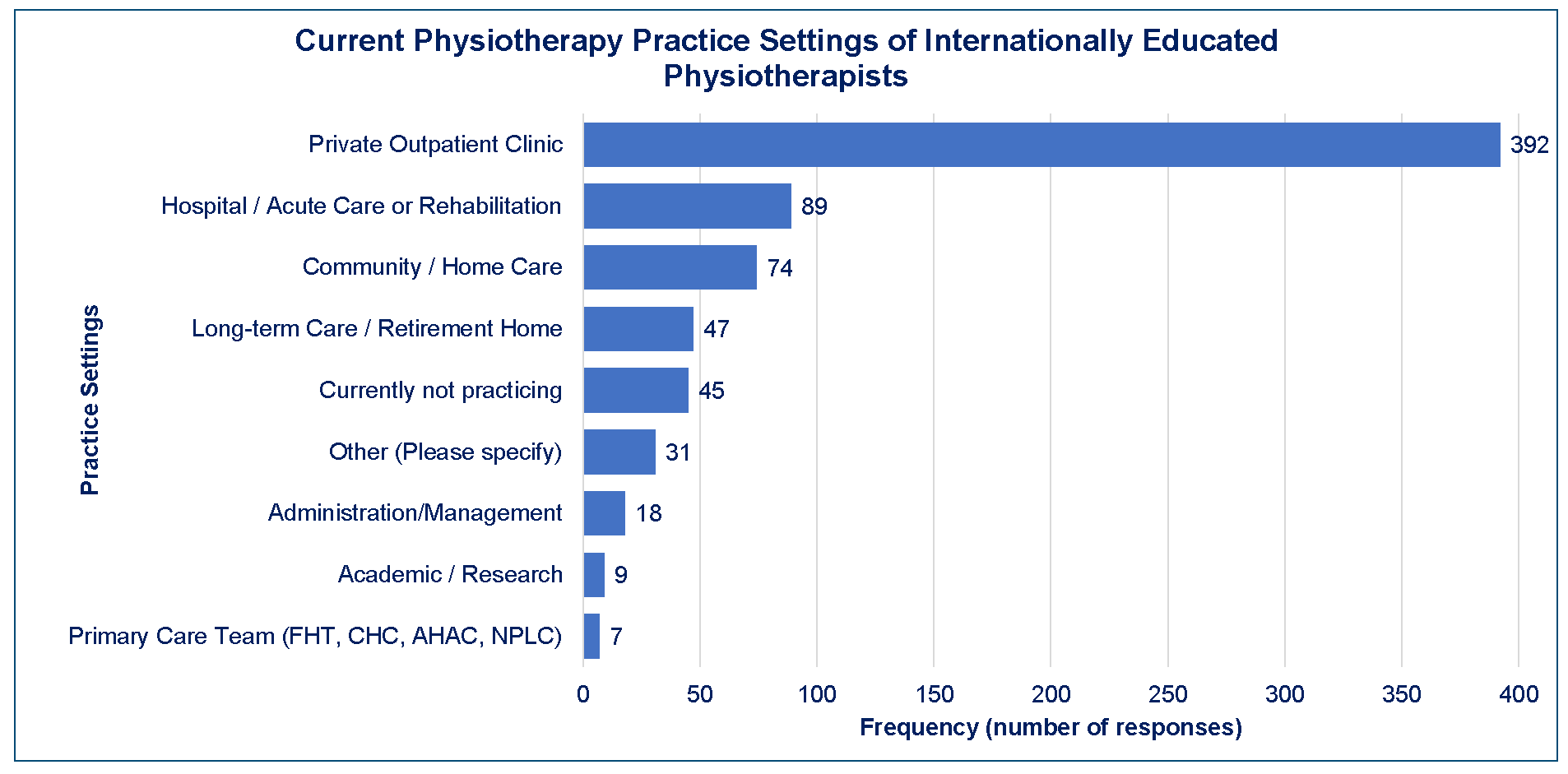
Most respondents work in private outpatient clinics (74%), followed by acute care and rehabilitation (17%), and home care (14%). The remaining respondents reported employment experience in areas of long-term care, administration, academia and primary care teams. (Figure 1).  

Figure 1. Self-reported practice settings by survey respondents (n=529) 

Key Outcomes and Themes 

IEPT Practice Settings Distribution

Acronyms: FHT = Family Health Team; CHC = Community Health Centre; AHAC = Aboriginal Health Access Centre; NPLC = Nurse Practitioner-Led Clinic.

Note: Respondents could select all that apply; therefore, the frequencies may sum to more than the number of respondents (n=529)

Analysis of both the quantitative and open-ended responses from the survey identified four main themes. 

1. Physiotherapist licensing in Ontario is perceived as lengthy, expensive, and difficult to navigate for IEPTs 

Licensing costs, credentialing reviews, examinations, and varying timelines were frequently cited as barriers to registration. Respondents also described challenges accessing clear information on requirements and exam preparation. 

“Overall, the transition to practice was much more challenging than expected.” 

“Expensive cost for the process of getting licensed.” 

“Too many steps and procedures, long process.”

2. IEPT Bridging programs appear to improve readiness for physiotherapy practice 

Respondents who completed bridging programs report smoother adaptation to Canadian practice. Nearly half of respondents (45%, n=239) identified CPO and bridging program guidance as the most valuable topic for OPA workshops and resources. 

“A stark difference between people who underwent Ontario International Educated Physical Therapy Bridging Program at UofT [and those] who did not, in adapting to and exploring various subcategories of PT career in Ontario.” 

3. Workforce integration challenges persist after licensure for IEPTs 

Respondents frequently reported employment challenges related to inconsistent work hours, compensation, workload, and completing documentation outside paid work hours. Some respondents noted that available employment opportunities did not align with their personal or professional values, contributing to feelings of dissatisfaction within the profession. Nearly one-third of respondents (32%, n=169) identified finding employment and navigating the recruitment process as one of their top three challenges when entering practice in Ontario. They cited knowledge gaps around practice settings, job expectations, and employment conditions. 

“Finding reliable employment.” 

“Finding full time working hours in private outpatient…Not getting paid for documentation from any employers.” 

4. Ontario practice systems remain difficult to navigate for IEPTs after registration 

Respondents identified the need for additional supports and training in understanding expectations related to the patient-clinician relationship, including: 

  • communication norms
  • trust-building 
  • consent
  • and shared decision making

266 respondents (50%) reported that, “Adapting to the Canadian healthcare system and patient expectations” were one of the top three challenges they faced since beginning practicing in Ontario. 

“I did not know where to start finding someone to answer my questions… and I’m from Ontario.” 

“Ethical rules, standards and resources that are different.” 

Next Steps for OPA 

OPA is turning the survey findings into action. The results of the survey have identified several opportunities to further engage with, and support, IEPTs who are transitioning to practice in Ontario. Importantly, 71% of respondents were not OPA members, and 62% were unaware of the services and support that OPA provides. This signals both a need and an opportunity to strengthen connections with IEPTs, with this survey engagement project being an important first step. 

Pathway to Licensure and Preparatory Training 

At the time of survey distribution and data collection, support resources for licensure preparation were largely limited to private preparatory courses, exam blueprints, and Canadian Alliance of Physiotherapy Regulators (CAPR) practice examinations. Since the survey closed (July 2026), CAPR has announced the development of a free CPTE preparatory course, available through a CPA student membership. This initiative may address barriers identified in the survey results. However, follow up evaluation would be required to determine if there is a significant improvement in the overall perspective. 

Additionally, CAPR has released the new Comparability Pathway, with accompanying resources to help support the road to licensure. OPA will continue to monitor the impact of these tools, while also identifying the opportunity to collaborate more closely with CAPR to promote early access to OPA member supports, as IEPTs go through the licensing process. 

Physiotherapist Practice Supports 

The challenges identified in relation to practice transition are often not unique to IEPTs, specifically, with respect to understanding employment opportunities and navigating the often-complex landscape of physiotherapy service delivery in Ontario. 

For this reason, OPA is exploring opportunities to provides supports that would meet, not only the identified needs by IEPTs, but also challenges experienced in the student to new grad transition in Ontario, and across the general membership, including: 

  1. Establishing opportunities for mentorship, whether in group or individual formats.
  1. Developing resources to support navigation through the public and private healthcare landscape in Ontario, including various funding models, such as WSIB, MVA, etc. 
  1. Expanding OPA’s existing resources on finding and evaluating job opportunities for physiotherapists in Ontario. 

The development and implementation of these opportunities will occur over the next several months. Be sure to stay tuned for future developments. 

Thank You to Survey Respondents 

OPA would like to extend a sincere thank you to all physiotherapists who responded to the survey. Your contributions have been invaluable in identifying opportunities for OPA to better support IEPTs. 

This work will not only support IEPTs in their journey; it will support some of the profession’s core priorities, including access to care, quality of care, workforce sustainability, professional standards and member support. Helping IEPTs integrate effectively into the Ontario healthcare system strengthens the entire physiotherapy workforce. 

For additional information on this initiative, please reach out to the Practice and Policy Team at OPA.